May 26, 2019 | Don Jail, Historical Moment, Louis Riel, Ontario
To mark the May rollout of my new website, here are a few memorable May moments from my Horrible History of Hanging in Canada:
-
- May 3, 1867: Ten thousand people turned up at the public hanging of Modiste Villebrun of St-Zephirin, Quebec, convicted of poisoning his lover’s husband. Even though this execution took place two months before the actual date of Confederation on July 1, 1867, it is officially listed as the first hanging in the newly formed Dominion of Canada.
-
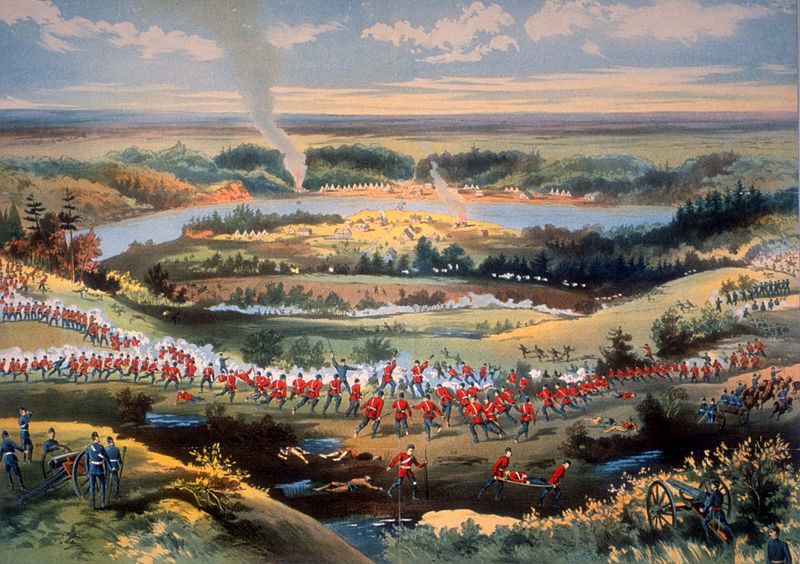
 May 12, 1885: Métis and First Nations rebel forces led by Louis Riel were defeated by Canadian government troops at the Battle of Batoche in Saskatchewan, and the Northwest Rebellion was over. Louis Riel was arrested by the North-West Mounted Police a few days later. He was tried for high treason, found guilty and hanged in November of that year.
-
 May 2, 1923: Emilio Picariello and Florence Lassandro were hanged for the murder of Steve Lawson, a constable with the Alberta Provincial Police. Lassandro worked for Picariello, a notorious rum runner during the dark and desperate days of Prohibition in Canada. She became the first, and last, woman ever to be hanged in Alberta.
-
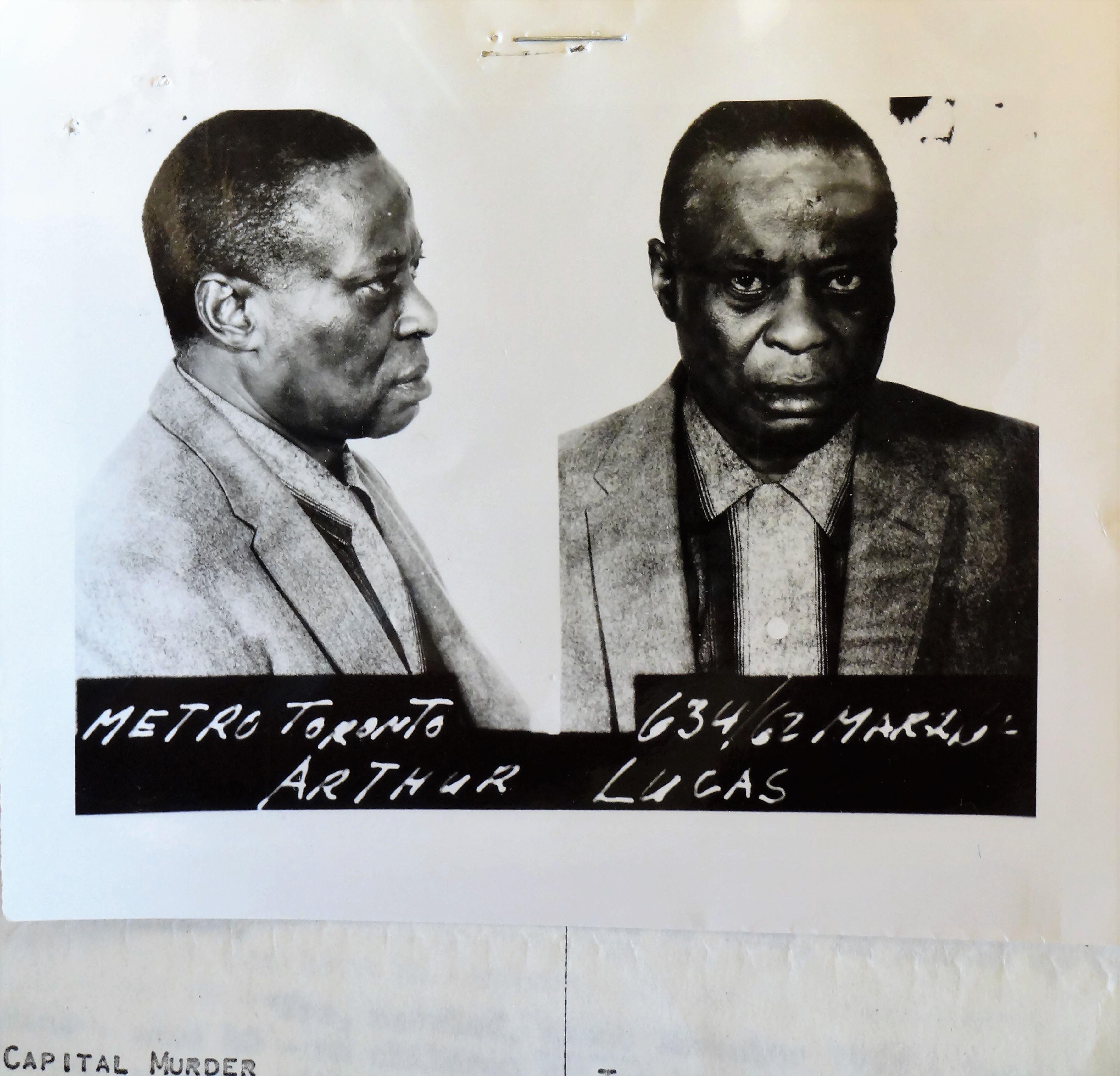
 May 10, 1962: Arthur Lucas, an African-American gangster, was convicted of the murder of Therland Crater, a police informant from Detroit. In spite of the fact that the case against him was purely circumstantial and seriously flawed, all appeals failed. Lucas was executed in a double hanging at the Don Jail on December 11. This was the last execution ever to take place in Canada.

Oct 24, 2018 | Death Penalty, Presentation, Women
“Canada’s New Death Penalty” was the provocative title of Mary Campbell’s presentation on Sunday, October 21, 2018, as part 1 of the Eglinton St. George’s Compassionate Justice Speaker Series.
Campbell, retired director general Corrections and Criminal Justice, began her talk by recognizing that although the death penalty still exists in some 50 countries worldwide, it was abolished in Canada in 1976, and a motion to restore it was defeated in 1987. What replaced the death sentence for first-degree murder was life imprisonment with no chance of parole for 25 years, and a sentence of between 10 and 15 years for second-degree murder. However, if prisoners merely remain in prison with no effort to rehabilitate them until they die —well, that’s a death sentence.
Unlike the case in the United States, where consecutive life sentences are allowed and people can serve what Campbell refers to as “eight life sentences plus 200 years,” life sentences in Canada are served concurrently. However, people with more than one life sentence “get to know maximum security very well,” and may well have to have a “conversion to sainthood” to get parole. (Note that there has been the odd exception: in 2017, for example, triple murderer Douglas Garland was sentenced to life in prison with no chance of parole for 75 years.)
In 2011, Stephen Harper’s Conservative Government managed to get around the fact that Canadian courts frown on consecutive death penalties by making parole ineligibility consecutive. This could mean, for example, 75 years of parole ineligibility for a prisoner serving 3 concurrent life sentences. When the Liberals came to power in 2015, they undertook to abolish what Campbell calls “the new death penalty,” but didn’t. So, effectively, people are given a “living death sentence.”
Campbell laments the loss of the “faint hope” clause, which previously allowed prisoners sentenced to life imprisonment with a parole eligibility period of greater than 15 years to apply for parole once they had served 15 years. “The program worked,” says Campbell. “There were no disasters.”
Campbell’s take-away message: We should not be asking what an offender deserves. The correct question is what we as Canadians deserve. Do we want to be the most unforgiving? Are we prepared to kill people in the name of the law? We should allow criminals the chance of redemption, of reaching some personal awareness that what they did was profoundly wrong.

Aug 11, 2018 | Locations, Quebec, Thomas Darcy McGee
Final resting place of Thomas D’Arcy McGee and Patrick James Whelan
Sharing the north slope of Mount Royal in Montreal with three other cemeteries is Notre-Dame-Des-Neiges, the largest burial ground in Canada, which was founded in 1854 originally to serve the Roman Catholic community.
Notre-Dame-Des-Neiges covers a whopping 343 acres in area, and more than one million people are buried there. While wandering along its 55 kilometres of pathways, you may come across the graves of notables such as René Angélil (1942–2016), manager and husband of singer Céline Dion; Robert Bourassa (1933–1996), two-time premier of Quebec; Maurice “Rocket” Richard (1921–2000), beloved star of the Montreal Canadiens hockey team; and politician and governor-general of Canada Jeanne Sauvé (1922–1993).
In the course of your wanderings you may also stumble upon the family mausoleum of Thomas D’Arcy McGee, who was cut down by an assassin’s bullet in April 1868. McGee was a charismatic poet, journalist, politician, and public speaker. He was also a Father of Confederation, a key player in negotiations with Britain prior to the establishment of Canada in 1867. He had been passionately opposed in his youth to the British domination of his native country, Ireland, but after moving to Canada he converted to the cause of peaceable political evolution.
As a result, he fell afoul of the Fenian Brotherhood, a secret society committed to violently overthrowing British rule in Ireland, and was denounced as a traitor to Ireland.
The man accused and convicted of assassinating McGee on the doorstep of his lodgings near the House of Commons in Ottawa one early April morning was Patrick James Whelan, a fellow Irish immigrant with Fenian connections. After a state funeral in Montreal, McGee was buried in his family tomb. Whelan was hanged for his murder at the Carleton County Gaol in Ottawa in 1869 and interred in an unmarked grave in the jail yard.
However, if you happen to carry on walking for some 8 minutes from the McGee mausoleum to Lot 00056 in Section GA of the cemetery, you’ll find a grave stone commemorating Patrick Whelan. How can that be? Whelan was buried in Ottawa, and his ghost is still said to stalk the hallways of the old jail.
Turns out that in the early 2000s, a box of earth was taken from the approximate spot where he had been buried in Ottawa and symbolically reinterred next to the remains of his widow in Montreal.
In life these two Irish immigrants had called Montreal home. And in a supreme stroke of irony, their memorials now stand in Notre-Dame-Des-Neiges Cemetery, a scant 400 feet from each other.
Jun 19, 2018 | Execution, Ontario, Women
June 19, 1873. Executed this day for the murder of her husband was Elizabeth Workman of Mooretown, Ontario.
A coroner’s inquest into the death of James Workman found that he died from “excessive violence,” administered by his wife or by Samuel Butler, the owner of a barbershop where Elizabeth did part-time work as a cleaner, or by both of them. There were bruises on James’s legs, indicating that they had been tied together with rope. The coroner found it necessary to mention that Butler was a Black man, the implication being that this was relevant to the case. Both Elizabeth Workman and Samuel Butler were taken into custody and charged with murder.
Witnesses at Elizabeth’s trial testified that a couple of days before his death in October 1872 James arrived drunk and belligerent at Butler’s shop, where Elizabeth was hard at work cleaning the floors. He insisted that she should come home with him. The barber intervened with some force, pushing James out into the street. Possibly not wanting a scene, Elizabeth left with her husband. However, she was so furious with him that, according to her young son, Hugh, she beat him severely with a mop handle, so severely that James was obliged to take to his bed. James was down but certainly not out. He continued to lash out verbally at his wife, and she responded by hitting him. She told a neighbour that she merely wanted to teach James a lesson to prevent him from hurting her in the future. Butler visited the house a couple of times during that period, but he was not there when James died.
The trial judge, Adam Wilson, ruled that although there seemed to have been an “improper intimacy” between Samuel and Elizabeth, the man should be acquitted as there was no evidence against him. However, when it came to Elizabeth, the judge was caustic. He characterized her as an adulterous and sadistic woman who tied her husband up and battered him for hours with a mop handle, finally killing him. Despite the jury’s plea for clemency, the judge followed up his negative statements at the trial with a letter to the minister of justice saying that he had nothing favourable to say about Elizabeth, and that she alone committed the acts she was charged with.
However, as Scott Gaffield points out in his thoughtful article “Justice Not Done: The Hanging of Elizabeth Workman,” the facts of the case were far more nuanced, and a vigorous defence might have brought these subtleties to light in court. The marriage of Elizabeth and her much older husband was very troubled. James laid claim to his wife’s earnings and was physically as well as verbally abusive to her, a trait very much exacerbated by his excessive drinking. Elizabeth, on the contrary, was described by all as a devoted wife and mother who was obliged to work outside the home to help her family survive.
Most of the evidence against Elizabeth was circumstantial and could have lent itself to alternative interpretations in the hands of a skilled lawyer. Did Elizabeth tie her husband down to brutalize him, or was this merely an act of self defence? Did Butler visit the house to protect Elizabeth rather than to cuckold her husband? And talking of Butler, the man had a fierce temper and he had been heard threatening James. Was the judge correct in dismissing the case against him, or did he actually have a hand in James’s death? Much of the physical evidence was gone. A neighbour and James’s daughter cleaned his body before the authorities arrived, and the alleged murder weapon, the mop handle, was thrown away.
But Elizabeth Workman’s defence was very much less than vigorous. When her trial opened in March 1873, the court found that she had no lawyer, and she could not afford to hire one. A local barrister, John A. Mackenzie, was hastily recruited to act as her lawyer. Mackenzie had a few short hours to familiarize himself with the facts and come up with a defence. All he managed to do was provide a statement of Elizabeth’s innocence. He did not question or challenge witnesses during the two-day trial, nor mention his client’s good character or the fact that she was more than likely a battered wife.
There was a huge groundswell of support for Elizabeth, not just from the public (118 people from the Mooretown area alone signed a petition protesting against her sentence) but from prominent members of the community such as the mayor and the sheriff, and even the future prime minister of Canada, Alexander Mackenzie.
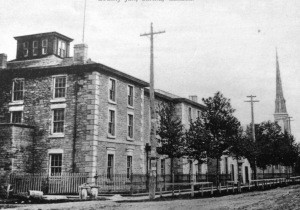
These efforts were all in vain: on June 19, 1873, clutching a small bunch of flowers, Elizabeth Workman was hanged. She fell directly into her grave through a trap in a purpose-built scaffold at the Sarnia Gaol in Ontario. She has gone down in history as the only woman executed in Canada despite a jury’s plea for mercy.

Apr 7, 2018 | Historical Moment, Thomas Darcy McGee
On April 7, 1868, exactly 150 years ago today, a high profile assassination shocked the people of Canada. Who were the victim and his alleged assassin? Where was the crime committed? What was the murder weapon?
Solving the puzzle will give you some of the answers.
Click the puzzle to start….then come back for Part 2 for more information on the crime that rocked the nation.


Aug 21, 2017 | Appearance, Canada, Death Penalty, Execution, Ontario, People, Presentation, Uncategorized
The heavens opened. Traffic slowed to a crawl. (I know. Two clichés in two sentences…) Nevertheless, people from all walks of my life turned up on Thursday evening, August 17 at Ben McNally Books in downtown Toronto to celebrate the launch of Drop Dead: A Horrible History of Hanging in Canada.
So many individuals were caught up in the criminal justice system between Confederation in 1867 and the abolition of capital punishment in 1976; I could only include a fraction of their stories in Drop Dead. So while the gathering at the launch sipped their drinks and nibbled on nibblies, I shared with them the story of a case that didn’t make it into the book: a murder trial after the circus came to Picton, Ontario, in 1903, which had a happier outcome than most.
And at the end of the evening, lucky, lucky Vanessa Judelman walked away with the draw prize: a gift package of books, notepads, and a bottle of The Hanging Man wine, with a length of rope thrown in to boot!