Jun 11, 2021 | Uncategorized
PAUL ROBERT SOLES (1930-2021)

“Imagine sitting down to question someone wearing a terrifying black mask with slits cut out for eyeholes! That’s what happened to CBC reporter Paul Soles in a television interview with Canada’s last hangman just before capital punishment was abolished in 1976.”
Excerpt from Drop Dead: A Horrible History of Hanging in Canada
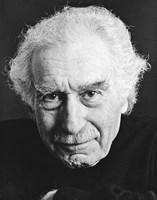
Looking like a deer caught in the headlights, Soles started by asking executioner John Ellis if he wore the mask for executions.
This was part of their conversation:
Paul Soles: Why are you wearing a black mask at this time?
John Ellis: This is just to keep my identity a secret.
Paul Soles: You don’t wear it at the time of an execution?
John Ellis: No. All I wear is a black suit, black bow, white shirt, and black shoes…. I’m not there to frighten him. I’m there to execute him.
Ellis made it clear that he was a firm believer in capital punishment. Asked about opponents of hanging, he told Soles: “they don’t realize just how humane it is. Unlike electrocution.… People want to die rather than spend life in prison.”
Later in the interview, Soles asked: “If the vote goes for abolition, and there’s no longer a need of a hangman, how do you think you personally will feel?” To which Ellis replied without hesitation, “Well, I’ll feel that I’ve served the country in the best way that I know how.… I have met the requirements that the country required. I’ve done my job and I’m retired.”
As I note in Drop Dead, the vote did go for abolition in 1976, putting an unceremonious end to Ellis’s professional life. According to one account, the retiree, then in his fifties, took to spending the winter months in Florida like thousands of other Canadian snowbirds; another report in 1984 had him living in the Bahamas. What is known for certain is that Ellis was not short of pocket money during his first few years of retirement. In November 1985, the Toronto Star reported that Ontario paid a “provincial executioner” $200 a month for a period of 8 years after the abolition of the death penalty, which, according to provincial auditor Douglas Archer, amounted to the tidy sum of $20,000.
Paul Soles, described in his Globe and Mail obit as “an actor, voice man, pioneering television broadcaster and twinkle-eyed adventurous soul with a hair-trigger wit,” died in Toronto on May 26, 2021. It is interesting to speculate whether Soles knew of this ironic turn of events in the life of Canada’s last executioner. And, if so, with his laser-sharp sense of humour, what he made of it.
Feb 27, 2021 | Uncategorized
Photo by DAVID JACKSON/THE GLOBE AND MAIL
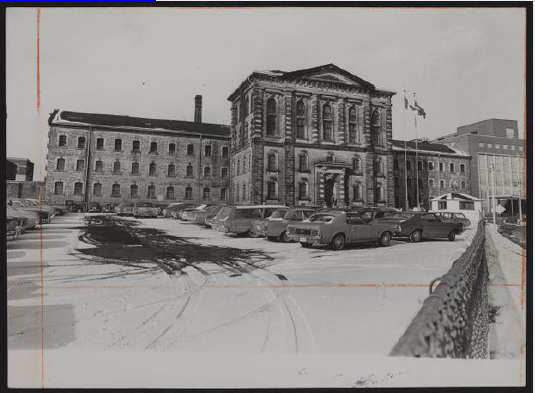
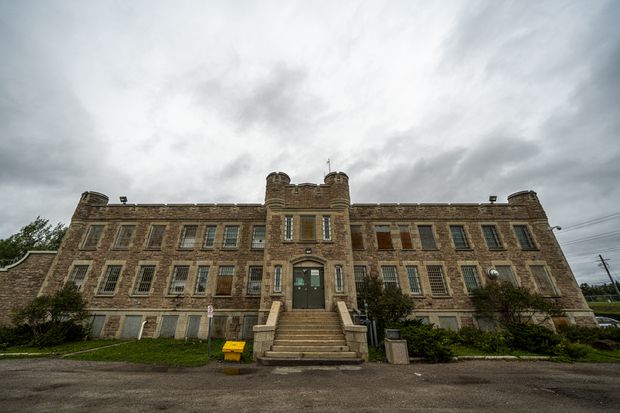
To figure out the future of the Thunder Bay District Jail, look to the past.
ORIGINALLY PUBLISHED IN THE GLOBE AND MAIL FEBRUARY 27, 2021
Dangerous, inhumane, unsanitary: just a sample of the litany of accusations levelled against the Thunder Bay District Jail in a blistering exposé published late last year in The Globe and Mail.
According to the report, the jail is critically understaffed and chronically overcrowded. Nine inmates have died since 2002, several from drug overdoses. An Indigenous man, Adam Capay, spent more than four years there in pretrial solitary detention. Inmate-on-inmate violence is rife. There was a riot and hostage-taking in 2015; 15 correctional officers refused to return. And more recently, an outbreak of COVID-19 has sent staff and provincial authorities scrambling.
A bleak fortress
The provincial jail, built in 1926, resembles resembles a bleak fortress, complete with turrets at the front entrance and the corners of the façade. If this building was designed to inspire terror, it has certainly succeeded beyond anyone’s wildest dreams, although not in the way originally intended. It has clearly failed both the guards and the guarded. Calls to close down the facility began in 1976 and have become increasingly insistent. Given the preponderance of Indigenous inmates among the jail’s population, some activists argue that a completely different option to incarceration would be appropriate.
The Ontario government, however, has other plans. The wheels move excruciatingly slowly, but eventually, perhaps by 2025, a new 325-bed facility will be built to replace both the antiquated jail and also the nearby Thunder Bay Correctional Centre. So that neo-Gothic house of horrors, riddled with mould and asbestos, will finally be shuttered.
And then what?
As has been the case with many obsolete correctional facilities in Ontario, the question will arise: What should be done with the structure once it has been shut down? Other grim relics of Ontario’s penal past have met with a variety of fates.
Despite vigorous protest, Kingston’s 118-year-old Frontenac County Jail, once the scene of judicial hangings of convicted murderers, was demolished in 1973. The site is now used as a parking lot. The Peel County Jail in Brampton, Ont., built in 1867 and closed in 1977, has been creatively incorporated into the Peel Art Gallery, Museum and Archives.
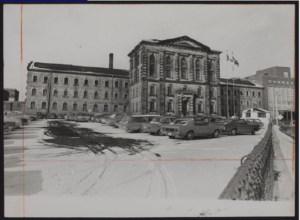 An interesting comparison is Toronto’s formidable Don Jail, which, in the late 1970s, was facing its own existential crisis.
The Don Jail
Located on the east side of the Don River, once remote from the city but now in the flourishing neighbourhood of Riverdale, this landmark was lauded as a “palace for prisoners” when it opened in 1864. The jail was based on progressive 19th-century penal reforms and state-of-the-art architectural principles.
However, it swiftly degenerated into what’s been called a “hell hole” where both inmates and staff were at risk of violence and death. Overcrowding became the norm. Other complaints over the years included unsanitary conditions, the intermingling of first offenders and seasoned criminals, corruption and mismanagement.
The end came in 1977, when then Ontario minister of correctional services, Frank Drea, told his fellow parliamentarians that he would “close the old Don Jail on Dec. 31, 1977 … forever.” The building would be replaced with a “massive” flower garden for the benefit of patients at the nearby Riverdale Hospital.
According to the media, Mr. Drea’s declaration was supported by all political parties. There were also calls from the public to “tear it down!” But many dissenting voices were raised. Historian Donald Jones, for example, wrote that “history cannot be blotted out by the destruction of buildings.” John Sewell, a former mayor of Toronto, credits a wildly successful poster campaign, urging Torontonians to “Take a closer look!” at the old Don Jail, with helping to save the building.
Heritage Preservation
With advocates of heritage preservation winning the day, what Mr. Drea referred to as that “magnificent monument to human misery” was not torn down. The jail mouldered away until the early 2000s, when an ambitious long-term project restructured the site at the corner of Gerrard Street East and Broadview Avenue. A slew of architects and heritage restorers collaborated to repurpose the Don as the administration centre for Bridgepoint Active Healthcare, which replaced the 1960s-era Riverdale Hospital.
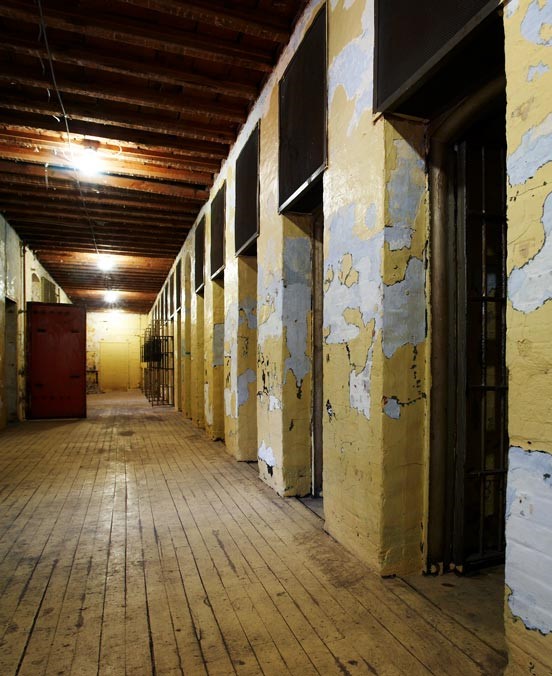
The heritage restoration called for the retention of significant elements of the Don’s grim past: notably, bars on some windows, several original cells, and the execution chamber where 26 men were hanged between 1908 and 1962. The actual gallows, however, are long gone.
“A place of incarceration to a place of healing”
Marian Walsh, former president and chief executive of Bridgepoint Active Healthcare, was the driving force behind the project. She contends that the transformation of the site has changed “a place of incarceration into a place of healing,” thus returning the jail to its reformist roots.
But we should never forget what lies hidden behind the bright white walls and light-coloured floors of the spruced-up building. The writer of a letter to the media in December, 1977, maintained that “it doesn’t matter now whether it stands, as the hurt has been done.” Toronto had “a self-made curse – because there will always be the words: ‘Remember the Don!’”
“Remember the Don!”
The importance of remembering cannot be overstated. Without memory, progress is impossible. My studies of the Don, past and present, however, have convinced me that erasure and “healing” are not enough. We need some form of monument to remind us of how we’ve treated our society’s outcasts.
Reflection, respect, remembrance of lives lost or tragically damaged, the expertise of heritage and related groups, and public engagement: These are just a few of the factors that the province and the City of Thunder Bay would do well to consider when the time comes to decide what to do with their death trap.
Dec 16, 2020 | Death Penalty, Don Jail, Uncategorized
THE COP KILLER AND HIS LAWYER
A recent obituary in the Globe and Mail highlighted the many facets of the career of Clare Elvet Lewis, who died in Toronto on October 24, 2020, at the age of 83. One of the various (and earliest) hats he wore in the course of his professional life was that of defence lawyer. It was in this role that he met up with a small-time criminal named René Vaillancourt, who cruised into Toronto from his native Montreal in January 1973 to rob a bank.
After spending the night of January 31 at the Gladstone Hotel, Vaillancourt drove across town to his target of choice: a Canadian Imperial Bank of Commerce branch at Danforth and Coxwell avenues in the east end. The 24-year-old was out on bail at the time on six charges, including possession of a dangerous weapon, car theft, and possession of stolen property. Reportedly, his specialty was stealing colour televisions from houses, stores and taverns in his home town. But he had become tired of the meagre pickings from his existing criminal activities. “I came to Toronto because the banks have more money in them,” he said later. “I was getting only $200 for B and Es [breaking and entering].” His optimistic assessment was spot on: using a .38 Smith & Wesson Special he had purloined from a policeman’s house in Montreal, he held up a teller at the CIBC branch and made off with almost $1800.
After dumping the 1965 Pontiac Parisienne he had stolen to use as a getaway car, Vaillancourt headed back to his own vehicle parked on nearby Drayton Avenue. There he encountered Leslie Maitland, a 35-year-old police officer who was in the area with trainee constable Brian McCullum investigating a robbery — probably the one Vaillancourt had just committed. “When I seen that he was coming for me I took out my gun…. I waved my gun at him…. He kept coming towards me. He wanted to catch me. I just shot and he fell down on the sidewalk,” Vaillancourt told police.
The bullet severed Maitland’s aorta and he was probably dead before he hit the ground. Vaillancourt shot him again, and followed this up by firing four times at McCullum, who, as a trainee, was unarmed. It was the young cop’s lucky day. He took shelter behind the police cruiser and all the bullets missed their target. But, as he grimly noted, “I could feel the spray of glass [from shattered car windows] on my face.”
Vaillancourt was captured while trying to escape in a taxi. “I killed the policeman,” he told investigating officers. “I want to get it over as fast as possible. I’ll plead guilty and draw my sentence. They will hang me for this but better that than being in jail all my life.” By the time his trial opened in September 1973, Vaillancourt had changed his mind. He pleaded not guilty.
 Vaillancourt had clearly pulled the trigger and he had clearly killed Leslie Maitland. More than 20 witnesses were prepared to attest to that. However, the accused’s lawyer, Clare Lewis, tried to prove “that Vaillancourt’s rational mind had disintegrated and that he could not realize the nature of the act that he had committed.” Psychiatrists and psychologists called by the defence testified that Vaillancourt had suffered brain damage at birth. He was described as impulsive, easily distracted, sadistic as a child, and sexually deviant; all of which, those experts argued, pointed to a diagnosis of minimal brain dysfunction. The jury preferred the version of Dr. Joseph Marotta, a neurologist at Toronto’s St. Michael’s Hospital, who found no evidence of abnormality in a neurological assessment of the defendant. Vaillancourt was found guilty of murder and sentenced to death by hanging — which was, back then, the penalty for the slaying of a police officer in Canada.
After their brief meeting in the early 1970s, the lives of the criminal lawyer and the cop killer followed very different trajectories. Lewis went on to occupy a myriad of other roles on the right side of the law: notably, judge, police commissioner and creator of the Special Investigations Unit (SIU) that investigates the police, and Ontario ombudsman. He was on the Ontario Review Board in 2010 when a debilitating stroke ended his public life.
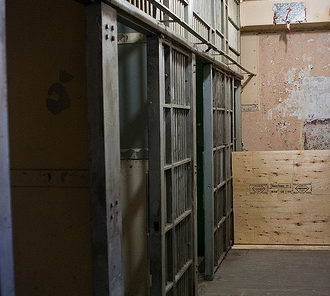
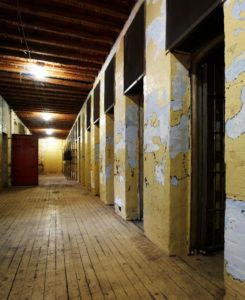
Vaillancourt was sent to death row at Toronto’s notorious Don Jail to await execution. He was still there a full 692 days later when he learned that he would not hang on October 31, 1975. He had been granted a nine-month stay of execution by solicitor-general Warren Allmand, pending the introduction of a bill abolishing capital punishment in Canada. On July 14, 1976, Bill C-84 squeaked through Parliament by a margin of seven votes, effectively putting the kibosh on the death penalty in Canada.
Vaillancourt’s sentence was commuted to life in prison with no chance of parole for 25 years. After his transfer to a federal penitentiary, Vaillancourt developed a new set of skills: he became a drug trafficker and ran an illicit mail-order business, abetted by his bewildered mother. He traded his own drug dependence for an addiction to computers. But his greatest claim to fame must surely be that he was the last convicted murderer ever to await execution on death row in the Don Jail.

Oct 18, 2019 | Uncategorized
Have you been dying for a new story from Lorna Poplak? Well, here it is!
“Off With His Head” is the true crime tale of German serial killer Eugen Weidmann, the last person to be publicly executed in ‘La Belle’ France, eighty years ago.
Recorded for a “Murder Was The Case” podcast, the radio play features Lorna Poplak, Lee Mellor, Nate Hendley, and Jacqueline Rendell.

Off With His Head
Written by: Lorna Poplak
Produced by: Lee Mellor
Read an excerpt:
Lorna: Summer 1939. As the clouds of war roiled over Europe, its citizens shimmied and jitterbugged and made whoopee. Life Magazine called it the most brilliant social season since 1914. People danced to “Deep Purple” in London, flocked to midnight concerts in Stockholm, and ogled “undressed” Czech refugee girls in Warsaw nightclubs. In the early morning of June 17, a crowd gathered outside the green door of St. Pierre Prison in the French city of Versailles to watch a different type of show, growing increasingly impatient when the performance was delayed — they “whistled and stamped and jeered like an ill-behaved movie audience.” As Life put it:
Newscaster voice: “Hundreds of Frenchmen and women had come fresh from late-closing cafes of Montmartre and Montparnasse to experience the exquisite excitement of seeing a man have his head cut off.”
Lorna: The man of the moment was thirty-one-year-old German serial murderer Eugen (Eugène to the French) Weidmann, who looked pale and haggard as he was hustled out by prison officials to the guillotine rigged up on the sidewalk.
By 4:30, as dawn lit up the now-silent spectators, it was all over…..