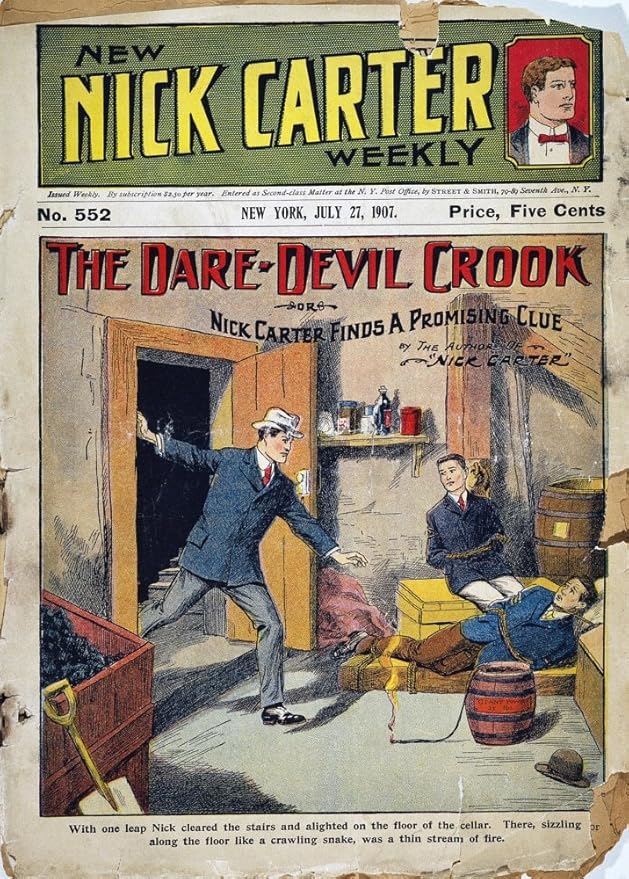
The first chapter of my upcoming true crime book On the Lam: Great (and Not So Great) Escapes from Prison describes the exploits of Ernest Cashel, a fugitive from United States justice who terrorized the North-West Territories (now Alberta) at the turn of the twentieth century.
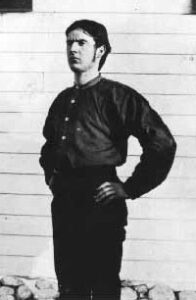
Ernest Cashel
In addition to being a serial escapee, twenty-year-old Cashel’s skills included forgery, robbery, and horse theft. Ultimately, he was arrested, tried, and convicted for the murder of a homesteader whose body was found floating in the Red River in July 1903.
Imprisoned in the Calgary police barracks in February 1904, Cashel enumerated the reasons for his exceptionally poor life choices. Surprisingly, dime novels were on the list. He said that they had filled his mind with wild and false notions of life, leading him “into bad habits, bad companions, bad women and early cigarette smoking.”
It’s this kind of bizarre detail that sends me straight down the research rabbit hole. Here is a brief summary of my findings.
Dime novels (I’m more familiar with the British equivalent, penny dreadfuls) were lurid, inexpensive paperback books featuring genres such as westerns, detective stories, and romances that were wildly popular in the United States from around 1860. They became a magnet for millions of kids and young, working-class readers.
Dime novels generally focused on the sensational exploits of a single larger-than-life hero (or heroine) who epitomized values such as courage, endurance, and strength — think Buffalo Bill, Wild Bill Hickok, and Calamity Jane.
Nick Carter Weekly dime novel from July 1907
There was no shortage of writers willing to try their hand at dime novels, and their output was prolific. According to the UK’s Historical Association, Frederic Marmaduke Van Rensselaer Dey, creator of street-wise detective Nick Carter (a particular favourite of Cashel’s), was rumoured to have churned out 25,000 words a week for almost twenty years, under different pen names. The high demand for these novels meant that authors could make between $200 and $300 apiece.
Several literary heavyweights started out as dime novelists — Louisa May Alcott of Little Women fame, for example, and Upton Sinclair, who wrote dime novels to finance his graduate studies before his serious writing career took off with The Jungle in 1906.
But Ernest Cashel was not alone in condemning the corrupting influence of these books. For instance, in 1882 the New York Times noted scathingly that the instructions about murder in dime novels led boys to regard it “as an elegant and desirable recreation.” And American anti-vice activist Anthony Comstock castigated the “vermin literature” for embracing violence and sensationalizing criminality.
By the early 1900s the craze had burned itself out, but dime novels transformed both the literary and pop culture landscapes in many different ways. They made books accessible to a wide audience and heavily influenced genres like romance, horror, adventure, and ghost stories, as well as more modern forms of entertainment such as movies, television shows, and video games.
The dime novel, as I discovered, has cast a long and lasting shadow.
This blog first appeared in the September 2025 Crime Writers of Canada monthly newsletter.