This super-old, super-long, superfamous one, of course!
In 1793, the British established a small settlement in Upper Canada on the northern shore of Lake Ontario. This was the garrison town of “muddy” York — now Toronto — neatly arranged in a little 10-block grid.
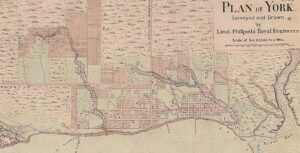
Plan of York drawn by Lieutenant Phillpotts of the Royal Engineers, surveyed in 1818 drawn in 1823.
To protect British strategic interests in the region, John Graves Simcoe, lieutenant governor of what would later become Ontario, envisaged an arrow-straight military road to cut through the hinterland and ultimately connect Lake Ontario at York with Lake Simcoe to the north. The first section opened in 1795. It was called Yonge Street. It was named for Sir George Yonge, the British secretary of war and a personal friend of Simcoe’s.
The claim that Yonge Street is the longest street in the world has been thoroughly debunked, but at 86 kilometres (including an extension from Bradford to Barrie) it is pretty long. In Toronto, it extends some 19 kilometres from Queens Quay to Steeles Avenue, splitting the city into east and west. And since the earliest days, Yonge, specifically the section south of Bloor Street West, has often been called “Toronto’s Main Street” — even “the heart of Toronto.”
So many examples stand out of what makes Yonge the hub of our city’s commercial, cultural and social life. To highlight just a few: In the late 1800s, retail giants Timothy Eaton and Robert Simpson chose to locate their respective department stores on Yonge. At 15 storeys, the Canadian Pacific Railway Building (built in 1913), as well as the 34-storey Commerce Court (1931) signalled the rise, both literal and figurative, of the modern corporation. Since 1914, audiences have flocked to performances at the double-decker Elgin and Winter Garden Theatres. Sam the Record Man opened in 1961, speedily becoming a mecca for vinyl lovers.
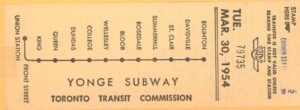
Toronto’s original subway line opened in 1954.
Public transit was modernized when the first stretch of Toronto’s subway system began operating beneath Yonge in 1954, establishing a vital (if not always reliable) new connection to the northern suburbs. The concrete, steel and glass of the Eaton Centre complex, on the southwest corner of Yonge and Dundas streets, has drawn in tourists and shoppers since the late 1970s. And civic celebrations, marches and parades (including the fabled 125-year-old Santa Claus Parade) typically wend their way along Yonge.
But downtown Yonge is not all glitz and glamour. During the 1960s and ’70s, in a section that became known as “Sin Strip,” sleazy body-rub parlours, strip clubs and sex shops proliferated, prompting then-mayor David Crombie to fume: “The street’s terrible.”
The shocking rape and murder in July 1977 of Emanuel Jaques, a 12-year-old shoeshine boy whose body was found on the roof of a body-rub parlour on Yonge, would trigger change on the strip. Intense public anger over the crime led to a police clampdown; sex workers were arrested, and sex-related establishments were forced to close. When three men were sentenced to life imprisonment for killing Jaques, the murder was widely perceived as a predatory homosexual crime.
Toronto’s gay community feared the worst, and with reason. Between the 1960s and ’80s, several bars along Yonge had begun catering to gay patrons. Foremost among these was the St. Charles Tavern, which hosted an annual Halloween party. Every year, as partygoers arrived in their spectacular costumes, homophobic mobs would pelt them with eggs and toilet paper, often chanting, “Kill the queers!” In 1977, around 140 cops were deployed to protect revellers, and 40 arrests were made. By 1981, community activism and harsh police measures had tamped down the so-called Halloween hate-fests. The epicentre of LGBTQ+ life in Toronto gradually shifted to its current location, Church-Wellesley Village, and Pride has since become an annual celebration.
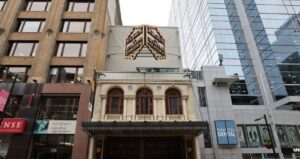
The Elgin and Winter Garden Theatres are seen amid the high-rises of Yonge Street, in downtown Toronto, on August 19, 2025.
Richard Lautens
Eaton’s, Simpsons and Sam the Record Man are gone, but Yonge Street has continued to reinvent itself. In 2002, the city embraced the opening of Yonge-Dundas Square, the bustling one-acre public space on the southeast corner of Yonge and Dundas streets, where hundreds of festivals, concerts, public-art installations and commercial events happen each year.
“Like it or not,” wrote Christopher Hume for the Star in 2012, “Toronto is a highrise city” — and Yonge has had its fair share of sky-high projects. Building sites clutter the roadway, often causing traffic diversions and snarl-ups. Perhaps fittingly, the tower now under construction at 1 Yonge Street is slated to become Canada’s tallest building. The proliferation of new builds has highlighted concerns about
heritage preservation; still, dozens of buildings on Yonge between King Street and College Street today are listed as heritage properties.
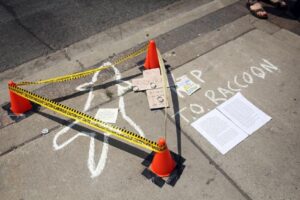
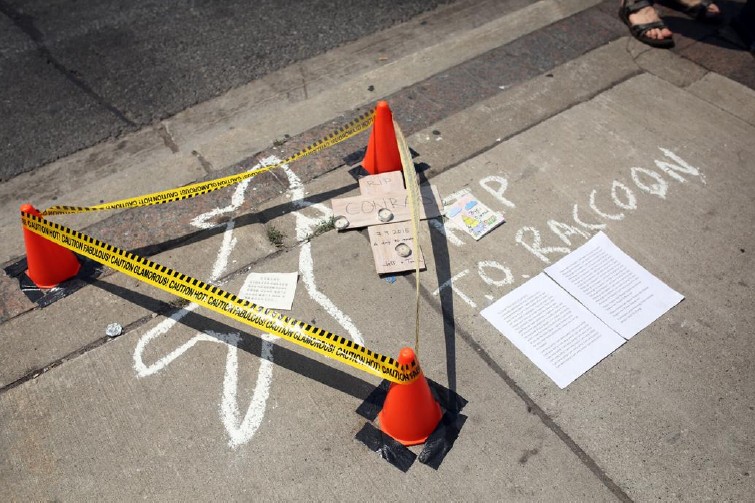
A chalk outline and memorial remain where a dead raccoon, dubbed Conrad by Torontonians, once lay on the sidewalk at the corner of Yonge Street and Davenport Road on July 11, 2015. Cole Burston/Toronto Star
If you asked Torontonians to name our official animal, most would say it was the raccoon. It’s actually the beaver, as attested by the city’s coat of arms, but the error is understandable: raccoons own the night in Toronto, and everyone has a story. In 2015, one such story went viral. On July 9, a dead raccoon was spotted on a Yonge street corner. A full 14 hours elapsed before it was removed. By then, starting with a single red rose, passersby had created an extensive makeshift memorial to the animal, nicknamed Conrad the Raccoon. And 10 years later, the rodent that touched Torontonians’ hearts was immortalized with an official heritage plaque.
Canada has long struggled with the widespread remainders and reminders of its colonial past, and anti-Black racism is among the core issues.
In 2020, the conflict came to Yonge when the record of 18th-century British statesman Henry Dundas, after whom Dundas Street is named, came under scrutiny. Critics say he delayed the abolition of the transatlantic slave trade; defenders say he was a committed abolitionist. An online petition signed by more than 14,000 people called upon the city to rename Dundas Street. That plan is currently on ice — it would cost millions. However, the city did push through with its decision to change the name of Yonge-Dundas Square.
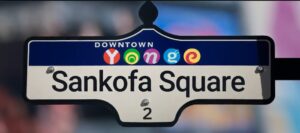 After two years of consultation and discussion, Toronto arrived at the name Sankofa Square. Inspired by the Akan tribe of Ghana, it refers to the concept of Sankofa, meaning to “go back and get it” — that is, to learn from the past. But many of the new name’s detractors suggest that something from Indigenous or Black Canadian history would have been more appropriate.
In 2025, the debate continues — another twist in the convoluted tale of Toronto’s quintessential street.
This article first appeared in the Toronto Star, August 23, 2025.